und Wörterbuch
des Klassischen Maya



Further Insights into a Late Classic Maya Relief Panel of Unknown Provenance, Repatriated to Mexico in 2025
Christian Prager and Antje Grothe
Bonn, July 23, 2025
https://doi.org/10.5281/zenodo.16368646
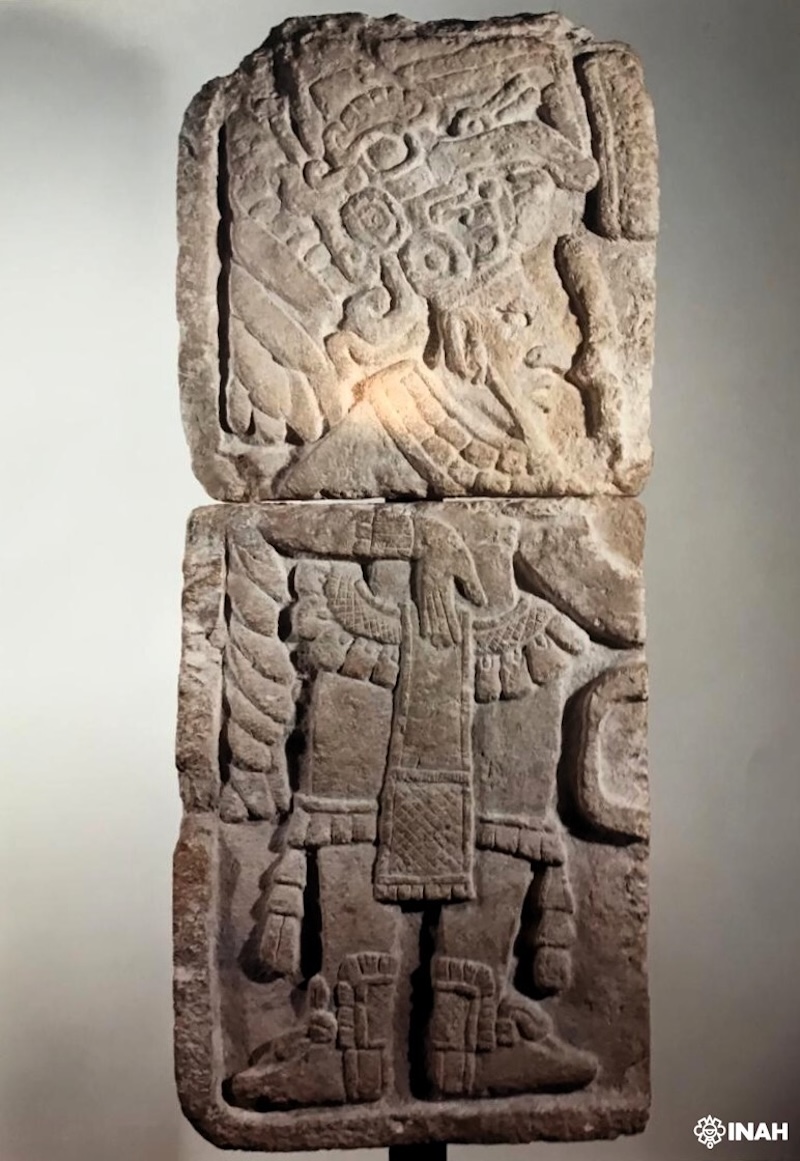
In May 2025, Mexico’s Instituto Nacional de Antropología e Historia (INAH) reported the repatriation of a fragment of a Late Classic Maya limestone panel from the United States to Mexico (INAH 2025) (Figure 1). Currently on display at the National Museum of Mexican Art (NMMA) in Chicago, the artifact had been held for decades in the private collection of Jeanne and Joseph P. Sullivan, Chicago. Following Jeanne Sullivan’s passing in 2023, the family’s heirs approached the NMMA to discuss the voluntary return of the relief panel to Mexico. Recognizing the artifact’s cultural and archaeological significance, the NMMA partnered with INAH to facilitate its repatriation. On February 1, 2025, the two institutions signed a formal Memorandum of Understanding, establishing a framework for the transfer and future collaboration (INAH 2025).
The artifact, featuring an elaborate relief carving, depicts a figure adorned with a mask and headdress, with both hands extended. It consists of two matching stone slabs, together measuring approximately 119 × 53 × 9.5 centimeters (INAH 2025). The panel represents the left-hand portion of an originally larger artefact dating to the Late Classic Maya period (600–900 CE) (Mayer 1987:22–23, 1991:Plate 117) (Figure 2). Unfortunately, the right half has disappeared from the public record and is currently under investigation by INAH (2025). However, already in 1987 and 1991, Austrian researcher Karl Herbert Mayer (1944–2025) described and illustrated the complete panel, suggesting that its probable origin lies in the Puuc region, which includes parts of present-day Campeche and southern Yucatán.
As a pioneer of provenance research, Karl Herbert Mayer studied the artifact extensively. Recent archival work by the authors, focusing on Mayer’s materials and publications, has helped trace the post-discovery trajectory of the relief panel and enhanced our understanding of its original composition and context (see below for further details). Among Mayer’s personal papers and photographic archive – recently bequeathed to the University of Bonn and the project Text Database and Dictionary of Classic Mayan – is an undated photograph from the Brooklyn Museum (New York) that shows the limestone panel in its original, undivided state. This image's caption also provides the measurements later cited by Mayer in his 1987 volume Maya Monuments: Sculptures of Unknown Provenance, Supplement 1, where he designated the piece as Catalog #29 (Unknown Provenance, Panel, KHM 4-29). He subsequently illustrated the complete panel in volume 6 of the same series (1991:Plate 117).
In its original condition, the panel's iconography features a triadic composition: two elaborately adorned human figures face each other in profile, with the figure on the right flanked by a little person holding what appears to be a fan or mirror. The iconographic content suggests a courtly or ceremonial theme, possibly related to dynastic representation or ritual performance. As an architectural element, the panel would have held a prominent decorative and symbolic role within a larger structure – likely serving as a door panel positioned above a temple or palace threshold – comparable to similar monuments found at Sayil, Kabah, Uxmal, or Xcalumkin (cf. Mayer 1987:22–23).
Provenance research indicates that by 1966, the panel had already entered the possession of American inventor and collector Lester Wolfe (1897–1983), having been illicitly removed from its original, still-unidentified archaeological context at an earlier, undetermined date. That same year, Wolfe placed the complete panel on long-term loan to the Brooklyn Museum in New York, where it was accessioned as L.66.5 (Brooklyn Museum 1965:125). It remained there until December 1977, as confirmed by a caption accompanying a published photograph (INAH 2025), after which it was returned to Wolfe.
By the late 1970s, the panel had entered the collection of the Snite Museum of Art at the University of Notre Dame – likely facilitated by Wolfe’s role as a benefactor and his close ties with the museum’s curatorial staff (University of Notre Dame 2005:10,13; Colón 2025). Notably, photographic evidence from the Justin Kerr archive at Dumbarton Oaks shows the complete panel still intact as late as July 1987 (personal communication Joanne Baron).
At some point after Kerr's documentation – and likely in late 1987 or early 1988 – the artefact was separated. To our knowledge, only the left-hand portion, consisting of two slabs, was subsequently exhibited at the Art Institute of Chicago in 1988 (Colón 2025). Shortly thereafter, it was acquired through a Chicago-based art dealer by Joseph and Jeanne Sullivan, who kept the piece in their private collection for more than three decades. Although it was not publicly displayed during this period, the family preserved detailed documentation of its provenance (Colón 2025).
 |
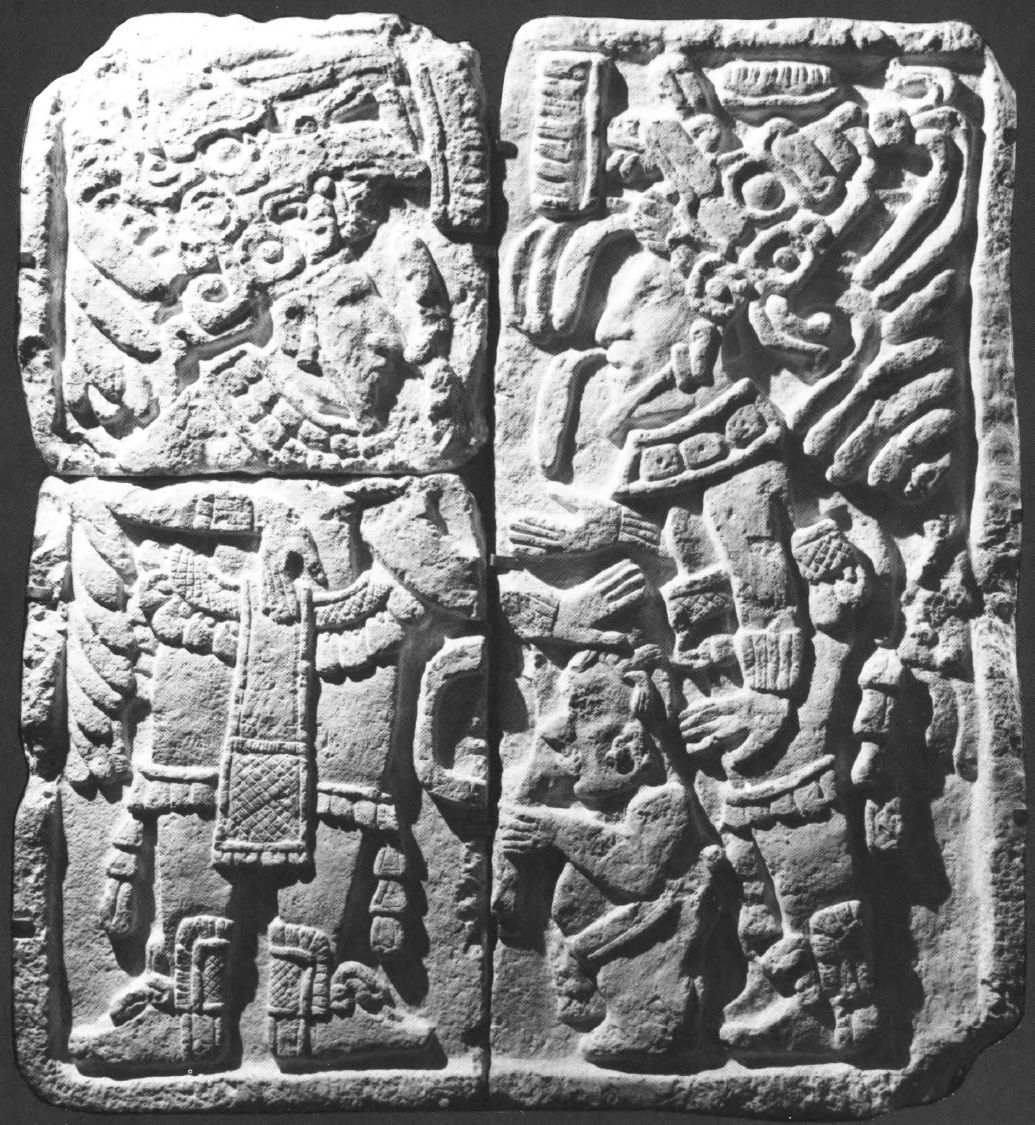 |
| Figure 1. Unknown Provenance, Panel (KHM 4 - 29), left portion (photograph courtesy Instituto Nacional de Antropología e Historia INAH, image citation from https://www.inah.gob.mx/images/boletines/2025/228/foto5.jpg, all rights reserved) | Figure 2. Unknown Provenance, Panel (KHM 4 - 29), complete (photograph courtesy Brooklyn Museum, before 1991, image citation from Mayer 1991:Plate 117, all rights reserved). |
 |
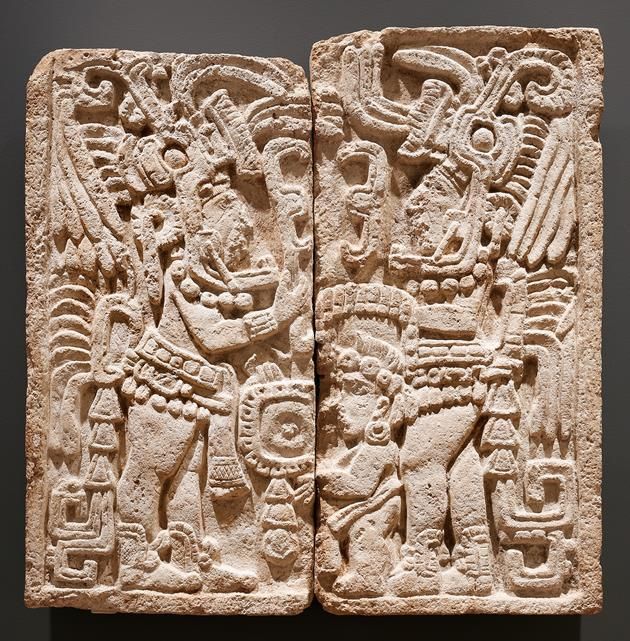 |
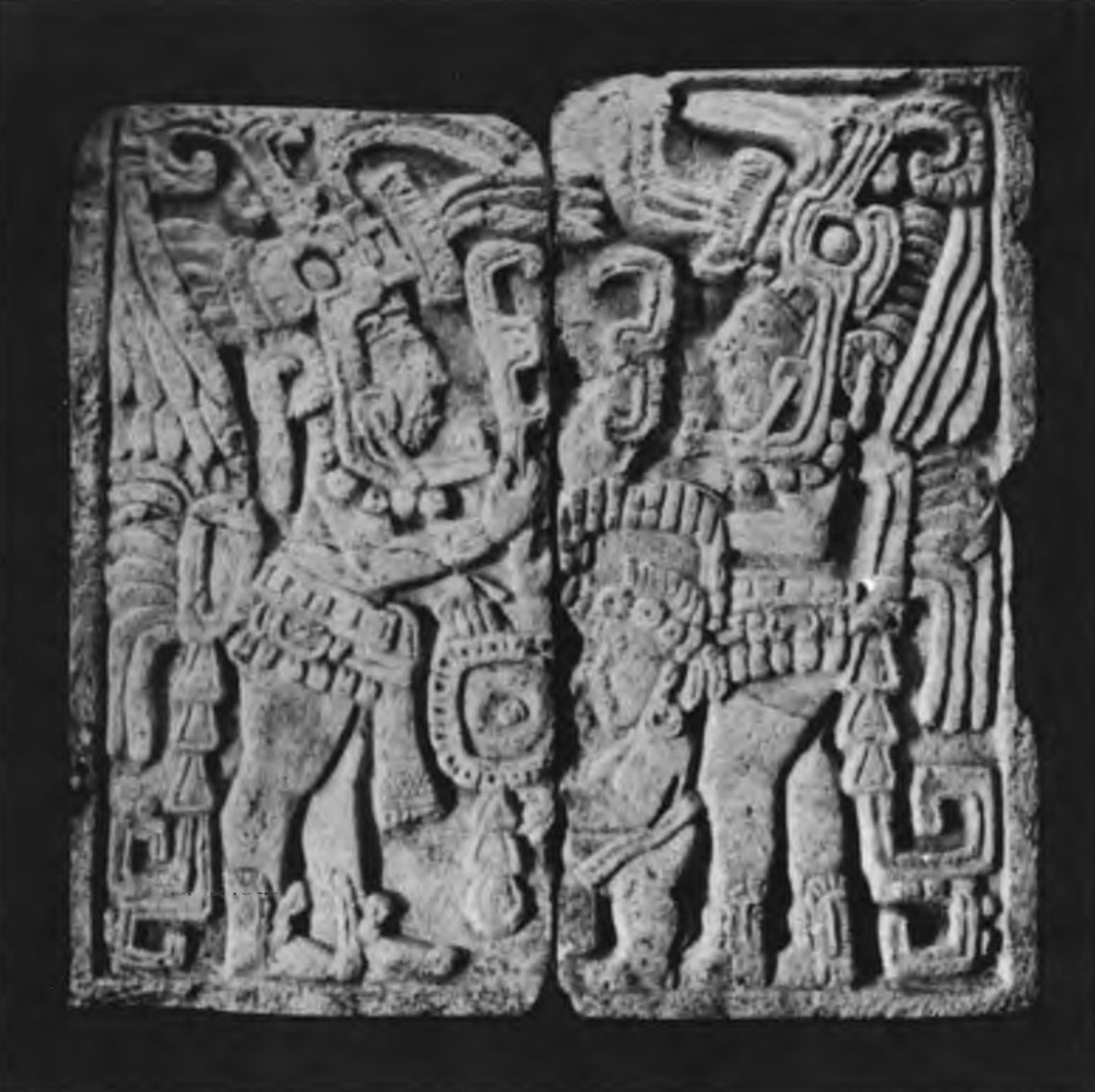
| Figure 3. Unknown Provenance, Panel (KHM 2 - 28) (photograph courtesy Jacquelin Stuart, before 1980, image citation from Mayer 1987, Plate 34, all rights reserved) | Figure 4. Unknown Provenance, Panel (KHM 2 - 28) (Photograph by Mark Woods, image citation from https://art.seattleartmuseum.org/objects/47103/relief-panels-door-reveals?ctx=bd6ea05a-9c86-4299-b0ef-9008f4f67e0b&idx=25, all rights reserved) |
Comparative analysis suggests that the panel forms part of a broader architectural corpus of sculpted door jambs and figural reliefs originating from the Puuc region of the northern Maya lowlands (Mayer 1987:22-23). In terms of dimensions, iconographic program, and carving style, it closely corresponds to an unprovenanced two-piece panel formerly documented in Los Angeles (Mayer 1980:37–38, Cat. No. 28) (Figures 3 and 4). Mayer already proposed that both reliefs may have derived from the same architectural monument – possibly part of a palace or temple structure - and originally functioned as door elements flanking or crowning threshold openings. Recent curatorial research conducted by the authors has confirmed that the panel described by Mayer is now held in the collection of the Seattle Art Museum, where it is cataloged under the accession number 2018.3.1 (Seattle Art Museum 2025). Carved from limestone and measuring 114.3 × 114.3 cm, the relief features a triadic composition: a central, little person stands between two elaborately attired male warrior lords holding weapons who confront one another in a mirrored posture.
While the correspondences between the two panels are striking, several unresolved issues remain. The exact archaeological provenance of both reliefs is unknown, and Mayer’s proposed connection remains hypothetical in the absence of in situ documentation. Moreover, despite the seemingly well-documented provenance of the Seattle panel in more recent decades, many questions still remain. According to museum records (https://art.seattleartmuseum.org/), the panel was already in the possession of the David Stuart Gallery in Los Angeles by 1961. It later entered a private collection in the same city by 1980, reappeared at Sotheby’s in New York in 1996 (Pre-Columbian Art Sale, November 25, Sale No. 6921, Lot 187), and was acquired in 1997 by Assen and Christine Nicolov of Seattle, who ultimately donated it to the museum in 2018.
If both panels did, in fact, originate from the same architectural context – as Mayer persuasively argued – then it must be assumed that the now-repatriated fragment was also removed from its original site no later than 1961, and likely under similar circumstances. This possibility highlights the pressing need to trace the intertwined histories of such works more thoroughly and transparently. The foundational contributions of our late friend and colleague Karl Herbert Mayer – whose life’s work was defined by an unwavering commitment to provenance research – remain essential in this endeavor. His publications continue to provide invaluable reference points for reconstructing object biographies and reuniting dispersed cultural narratives.
The present note is written in memory of "Karli" Mayer, whose meticulous documentation, scholarly publications, and decades-long commitment to Maya hieroglyphic studies were instrumental to this research. The rediscovery of key photographs and records in Mayer’s personal archive – now housed at the University of Bonn – proved essential for reconstructing the panel’s original composition and tracing its fragmented provenance. His foresight in systematically collecting and preserving visual and textual materials on unprovenanced monuments has not only enabled the insights presented here but continues to serve as a model for provenance research and cultural heritage reconstruction more broadly.
The case of these limestone panels underscores not only the critical importance of archival scholarship but also the complexities of what might be termed “partial repatriation,” in which only fragments of looted heritage can be recovered. Nonetheless, the voluntary return facilitated by the Sullivan family – through transparent channels and informed by scholarly collaboration – sets a powerful precedent. Through their gesture, a displaced cultural artifact has moved one step closer to its historical and cultural context, and a fragment of ancient Maya heritage has been recontextualized with dignity and care.
References Cited
Brooklyn Museum
1965 Additions to the Museum Collections. The Brooklyn Museum Annual 7:119–132. https://www.jstor.org/stable/26457348.
Colón, Ambar
2025 Museum Facilitates Return of Mayan Artifact from Chicago Philanthropist’s Collection. Electronic Document. Chicago Sun-Times. https://chicago.suntimes.com/art/2025/05/16/mayan-artifact-returned-from-a-chicago-philanthropists-collection.
INAH
2025 Recibe México fragmento de panel maya, en Estados Unidos (Boletín No. 228). Electronic Document. INAH. https://www.inah.gob.mx/boletines/recibe-mexico-fragmento-de-panel-maya-en-estados-unidos.
Mayer, Karl Herbert
1980 Maya Monuments: Sculptures of Unknown Provenance in the United States. Maya Monuments 2. Von Flemming, Berlin.
1987 Maya Monuments: Sculptures of Unknown Provenance, Supplement 1. Maya Monuments 4. Von Flemming, Berlin.
1991 Maya Monuments: Sculptures of Unknown Provenance, Supplement 3. Maya Monuments 6. Von Flemming, Berlin.
University of Notre Dame
2005 Selected Works. Snite Museum of Art, University of Notre Dame. University of Notre Dame, Notre Dame, IN.